Somehow it felt appropriate for a month long tour of Michigan to start here in Toledo. But, first things first. Toledo, Ohio is named after Toledo, Spain, which in turn takes their name from the Latin "toletum" or City of Generations.
When the city was first incorporated in 1833, it was considered to be a part of the Michigan Territory. Considering its location on the Maumee River and the western edge of Lake Erie, the city was destined to grow. Ohio claimed their official state border was just a bit north and would include Toledo.
Borders were surveyed and resurveyed. Neither side was willing to back down. Gov. Lucas of Ohio and Gov. Mason of Michigan both sent their militia to settle the matter. Both set up camp on their side of the Maumee River.
The U.S. Congress had been aware of what was going on, but had other priorities. A potential military skirmish made them take notice. A compromise was offered and accepted. Michigan would give up its claim to Toledo. In turn, the territory would get the Upper Peninsula and the process of statehood would be sped up.
As for the militias, there were a few reports of guns being fired in the air and some taunting back and forth across the river.
The first thing I checked was the schedule for the Toledo Mudhens. They're the AAA team for the Detroit Tigers. Unfortunately, they were playing in Indianapolis against the Indians.
Instead, I simply chose to explore a few of the area's parks. I decided to start south in the suburb of Grand Rapids. Providence Metropark sits alongside the Miami and Erie Canal which was built to connect Toledo and Cincinnati. Legend has it the townspeople from Gilead(now Grand Rapids) weren't too happy the canal was bypassing them. So, they snuck out at night and sabotaged the day's work. In the end, the canal builders relented and built a nine mile spur.
At the headwaters of the canal, they build a timber dam to deflect just enough water into the canal.

The timber dam was replaced by concrete in 1908, then refurbished in 1991.


The Toledo, Lake Erie and Western Railroad hasn't used this bridge in a long time. I passed a section of the track a half mile away when it crossed the road. Long sections of the actual track were gone and overgrown.

About a half mile up the canal towpath is the Isaac Ludwig Mill. It's not the first here. The Manor Mill stood here until the state declared eminent domain and tore it down to build the new canal. Peter Manor worked a deal where he would be able to build a new, bigger mill once the canal was completed.
Manor hired Ludwig to build the mill just before his passing. Ludwig bought the property and continued to build the mill.

If you keep walking a short way down the canal, you'll come across a replica of a canal boat, once towed along by mules. During tourist season, there are tours up and down the canal.


Walking back along the towpath towards the car, I walked under a roadway overpass. The sun was reflecting off the water and dancing on the underside.

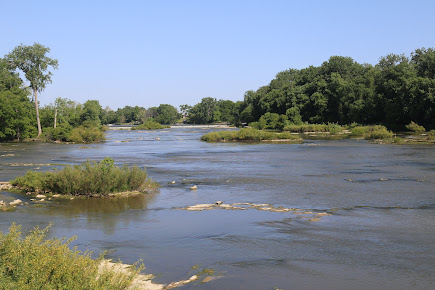
Just for kicks, I did drive across the river to downtown Grand Rapids. While the rapids didn't look too grand, I could imagine trying to get a boat down this section of the river.
I drove back towards Toledo along Hwy 24. A few exits east is the turnoff for the Fallen Timbers Battlefield. On the grounds is a mile and a half trail through the site with historical markers along the way.

In 1794, the United States was pushing its boundaries westward, establishing military forts and outposts. That summer, a confederation of Native-American tribes decided to do something about it. The two sides clashed in the woods on the site. The name Fallen Timbers refers to the area of forest where the battle took place. Years before, a tornado had touched down and toppled trees here.

Across from it sits the memorial for the Native-American dead. Legend has it Chief Turkey Foot addressed his forces while standing on that rock. 
There's a third, much larger memorial in the park, dedicated to the signing of the Treaty of Greenville.

The local tribes weren't the only ones concerned about America's expansion westward. While the Treaty of Paris gave ownership to the United States, Britain refused to give up their forts and continued to occupy the area. The contention being, we hadn't paid our debts to them yet. While under orders not to fire upon Americans, they paid close attention to the battle taking place just up the road.


Never gets old...


Most of you will recognize the name from M*A*S*H where Max Klinger mentions them six times. The first time he said "If you are ever in Toledo, Ohio, on the Hungarian side of town, Tony Packo's got the greatest Hungarian hot dogs." And yes, they do have photos from the show.


He also told me about something called "Beer Poking." In the dead of winter, you let your stout get slushy from the cold, they stick a red hot poker into the beer before serving it hot. The heat of the poker partially carmelizes the sugar giving the beer a different flavor.
In downtown, the City of Glass Metropark sits along the Maumee River and celebrates the city's nickname as well as it's status as the largest supplier of glass in the country.
In 1888, Edward Libbey moved the New England Glass Company to Toledo and renamed it Libbey. With an abundance of natural gas, easy access to steamships and railroads, as well as plenty of high quality sand, he felt it was a natural move. And they're still there.


Seen on the back of a car in the parking lot.


The Hotel Lorraine first opened its doors in 1925. The interior was designed to "produce a homelike atmosphere and attractiveness uncommon to hotel life." Other hotel owners were invited to the grand opening and one described it as "the last word on modern construction, equipment and furnishings."

I drove back towards Toledo along Hwy 24. A few exits east is the turnoff for the Fallen Timbers Battlefield. On the grounds is a mile and a half trail through the site with historical markers along the way.
In 1794, the United States was pushing its boundaries westward, establishing military forts and outposts. That summer, a confederation of Native-American tribes decided to do something about it. The two sides clashed in the woods on the site. The name Fallen Timbers refers to the area of forest where the battle took place. Years before, a tornado had touched down and toppled trees here.
The British had been allied with the local tribes, but were skittish about getting into another armed conflict. When it was clear only limited help would be offered, the tribes agreed to negotiate peace. A year later, the Treaty of Greenville was signed opening even more land to settlers in what we now know as Ohio.
While the battlefield in on the north side of Hwy 24, the memorials are in a park on the south side. This is for the American dead in the battle...
Across from it sits the memorial for the Native-American dead. Legend has it Chief Turkey Foot addressed his forces while standing on that rock.
There's a third, much larger memorial in the park, dedicated to the signing of the Treaty of Greenville.
The local tribes weren't the only ones concerned about America's expansion westward. While the Treaty of Paris gave ownership to the United States, Britain refused to give up their forts and continued to occupy the area. The contention being, we hadn't paid our debts to them yet. While under orders not to fire upon Americans, they paid close attention to the battle taking place just up the road.
Fort Miamis is long gone, but you can still see the trenches and gully the British troops dug to protect it.
I still wasn't thinking about lunch, so I drove out to a place called the Manhattan Marsh. The marsh used to be much larger and the city restored this section as a wildlife preserve.
Never gets old...
There's a 1.3 mile loop trail around the marsh. It's mostly level and well maintained.
We've all seen Cottonwood seeds drifting through the area. What I hadn't seen were drifts of them collecting alongside the ground. Best guess, they're about eight inches tall.

The backside of the preserve runs alongside an active railroad. A trail leads to the back entrance and another small parking lot. Never gets old...


Actor Jamie Farr grew up in Toledo. In 1998, the city renamed his childhood park in his honor.
No visit to Toledo would be complete without a visit to Tony Packo's. The son of Hungarian immigrants, he borrowed $100 from relatives to open a sandwich and ice cream shop in 1932. He took Hungarian sausage, sliced them, added some sauce and served it on rye bread. They were an instant hit in the neighborhood. Tony's son runs the place now and they're up to five restaurants.
If you get them all the way, it comes with mustard, sauerkraut, secret sauce and chili. Tasty, but I didn't feel the need to eat the rest of the day.


Most of you will recognize the name from M*A*S*H where Max Klinger mentions them six times. The first time he said "If you are ever in Toledo, Ohio, on the Hungarian side of town, Tony Packo's got the greatest Hungarian hot dogs." And yes, they do have photos from the show.

Years ago, actor Burt Reynolds visited and was asked for an autograph. So, he signed a hot dog bun.

On the restaurant walls you can seen hundreds of them from politicians, celebrities and famous musicians.


After lunch I took a drive over to Quenched and Tempered Brewing Company.

I did my usual flight of four. The brewmaster was milling about and asked what I thought. I told him I was curious about one of them because I couldn't place the flavor. He rattled off a long list of hops he had used to make it and give it that flavor. He then insisted I try samples of more. We wound up talking for quite some time. He even gave me some advice for a few stops further on the adventure.

He also told me about something called "Beer Poking." In the dead of winter, you let your stout get slushy from the cold, they stick a red hot poker into the beer before serving it hot. The heat of the poker partially carmelizes the sugar giving the beer a different flavor.
In downtown, the City of Glass Metropark sits along the Maumee River and celebrates the city's nickname as well as it's status as the largest supplier of glass in the country.
In 1888, Edward Libbey moved the New England Glass Company to Toledo and renamed it Libbey. With an abundance of natural gas, easy access to steamships and railroads, as well as plenty of high quality sand, he felt it was a natural move. And they're still there.
On the north-eastern end of the park is where you'll find the National Museum of the Great Lakes. There's the museum itself, but also tours through a tugboat and a really big freighter.
Seen on the back of a car in the parking lot.


On the drive back to the motel, I caught the red light by the Hotel Lorraine. It certainly looked like a place with some history.
The Hotel Lorraine first opened its doors in 1925. The interior was designed to "produce a homelike atmosphere and attractiveness uncommon to hotel life." Other hotel owners were invited to the grand opening and one described it as "the last word on modern construction, equipment and furnishings."
J.A. Hadley, the hotel's owner declared "the carrying of ice water by bellhops...will be eliminated by ice water lines to all rooms. A large ice machine in the basement of the building refrigerates the water for the rooms."
Hadley had successfully run other high end hotels in the city before taking on the Hotel Lorraine, The question was, why in this spot. It wasn't exactly a high rent neighborhood.
By the 1960's it was mostly bars, By the 1970's the neighborhood had been nicknamed the Jefferson Avenue Circus. The bars had become a little more seedy, strip clubs had moved in and the prostitution was out in the open.
The hotel went downhill, just like the neighborhood. The doors were finally shuttered in 2019 after the new owners were convicted of fraud. WTOL-TV did a report in the closing of the hotel, where it had become low income housing. You can see that here:
Reporter Caylee Kirby got a look inside as it went to auction. You can see her report here: